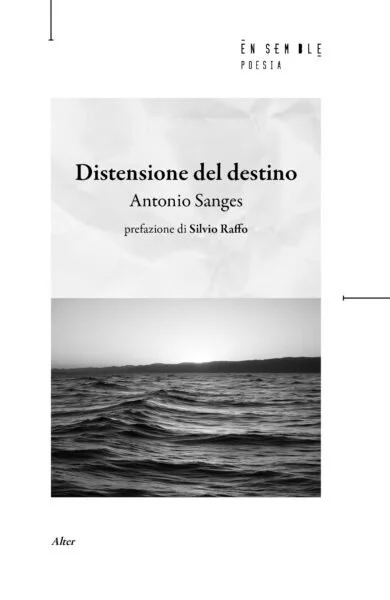
Distensione del destino (Ensemble 2025)
EXCERPTS (In Italian)
La chiarezza del mare
Ascolta: ancora l’onda
non è tiepida abbastanza
per distruggere l’indifferenza
del mondo.
È troppo guardinga e sospettosa
per convincere l’uomo
che non è questa l’altissima sorte:
cellule, materia, morte.
Ma guarda l’orizzonte
meridiano al fiorire pullulante
della luce, dell’alba dietro al monte.
E guarda ancora la barchetta placida
sconvolta nella sua bella andatura
da un’onda più inquieta, più matura.
E guarda sotto alla superficie
quello che non si può guardare:
l’abisso del mare.
E immagina
quello che non si può immaginare:
il mito, il Mediterraneo,
amare il mare.
È un giorno chiaro e superficiale:
guarda la profonda essenza del mare.
Congedo
È tempo di ricomporsi.
Troppo dolore ottunde.
Troppa passione devasta.
Troppo sentire è banale.
Incamminiamoci festanti
sulla via del crepuscolo.
Troppo abbiamo sofferto.
Troppo abbiamo vissuto.
Troppo abbiamo sentito.
E se un giorno
dal nuovo mondo
qualcuno mi ascolterà
non potrà sentire
ciò che io ho sentito perché
io sono un graeculo nell’impero
romano
io sono l’ultimo ciarlatano
io sono l’ultimo essere umano
io vedo chiaramente
io vedo l’avvenire
io vedo il barbaro
alle porte
io vedo sprofondare
nell’oblio
fato, mito e morte.
Ci si agita per niente
ma è nel nostro sangue.
Finalmente
un giorno in Occidente
un passante ascolterà
il canto delle Muse
e l’Alleluia nelle Chiese.
Non potrà capire perché abbiamo lottato.
Non potrà sapere
che cosa abbiamo perduto.
Ma disperare non è dato.
Lottiamo.
È il nostro fato.
Rebecca Sisti reads “La sfioritura”
Reviews
Reviews originally published in Italian. English translations by the author.
Preface by Silvio Raffo
Antonio Sanges’s new collection can be read as an uninterrupted dialogue between a demanding and restless soul and the ghost of an arid, ungenerous Nature, alongside ambiguous divinities that are more mocking than benevolent. It is a poetry of negative theology, of Montalian “glimmers,” of “hidden words” which, when they do reveal themselves, do so only to further confuse. The exploration is cautious; pauses over chasms and abysses offer no respite. The seasons play a central role, yet at first it is the wintery side that seems to prevail. Raindrops become the “tears of the gods,” enigmatic entities engaged in a game of hide-and-seek, presiding over a kind of farcical representation whose meaning perhaps even they themselves ignore.
— Silvio Raffo, Preface
Review – Poetrydream (25 August 2025)
Marco Tabellione
The new book by Antonio Sanges opens with a progressive poetic triptych—“Winter,” “Inferno,” and “Interior”—three poems that immediately draw the reader into an immersion in contemporary follies, moving between claustrophobic spaces and, conversely, landscapes that open onto freedom and breath. At times this opposition is not stated explicitly, but suggested beneath apparently neutral descriptions. Sanges’s poetic world is populated by nature, landscapes, places, and non-human objects: a world that is indispensable, yet from which the poet derives the key to a dissension, a contrast—or rather, a dramatic separation—between nature and the human.
Review – Diacritica (Issue 56)
Marino Alberto Balducci
While in Poland, where I am currently based, I read Sanges’s book. His poetry convinced me, prompting a personal reflection on the complexity and sincerity that distinguish it. I was also struck by the value of a coincidentia oppositorum noted by Silvio Raffo in his preface, which insightfully introduces the text and highlights the resolving tension between despair, dismay, and an unexpected, unmotivated hope. The author’s language displays immediate clarity and a simplicity that conceals treasures: philosophical concepts condensed into emotionally charged images.
Review – L’Ombra delle Parole
Giorgio Linguaglossa
Sanges’s poetry occupies a liminal position: no longer pure elegy, yet not fully a postmodern event of historicity; no longer diaristic closure, yet not multilingual fragmentation. It is a poetry that remains aware of the power of song, even as it tempers its emphasis (“let us avoid the languid clamor of song”), seeking a balance between the memory of the past and the possibility of a shared future.
In this sense, Distension of Fate is a writing of resistance and existence: resistance to the dissolution of poetry into private chronicle, resistance to the fragmentation of language, and existence within a world moving toward historicity. It is a poetry that preserves in order to transmit, that safeguards in order to loosen, and that continues to entrust language with the task of bearing witness—even when words appear worn, even when song seems useless, superfluous, merely decorative.
Critical Note – Marco Palladini
L’Age d’or
A poetry of destiny which, at its threshold, seems to embrace an oblique form of amor fati, subtly emerging in the verses of the final eponymous poem, which appears to have been written by a post–Don Quixote.
TRANSLATIONS
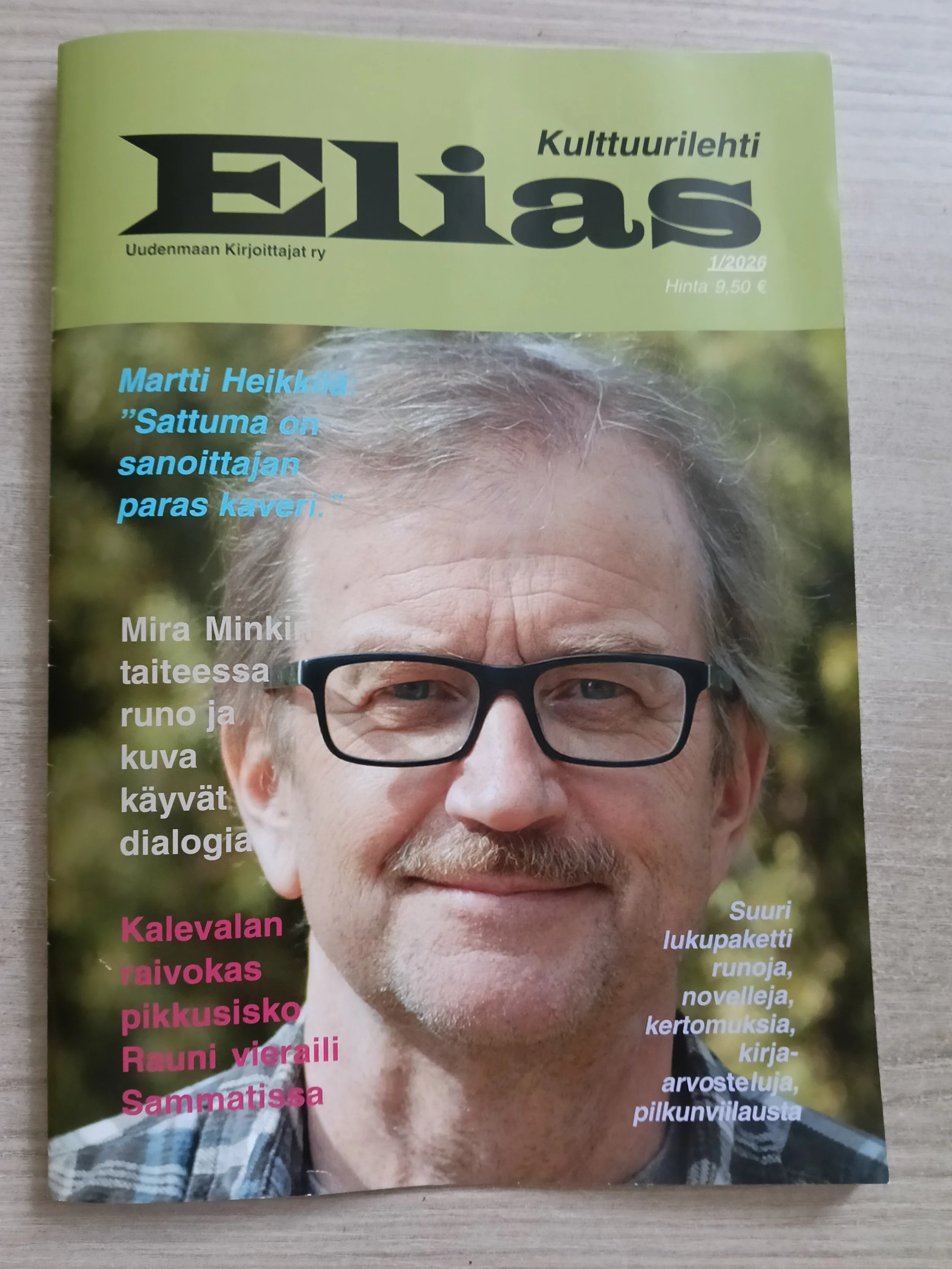
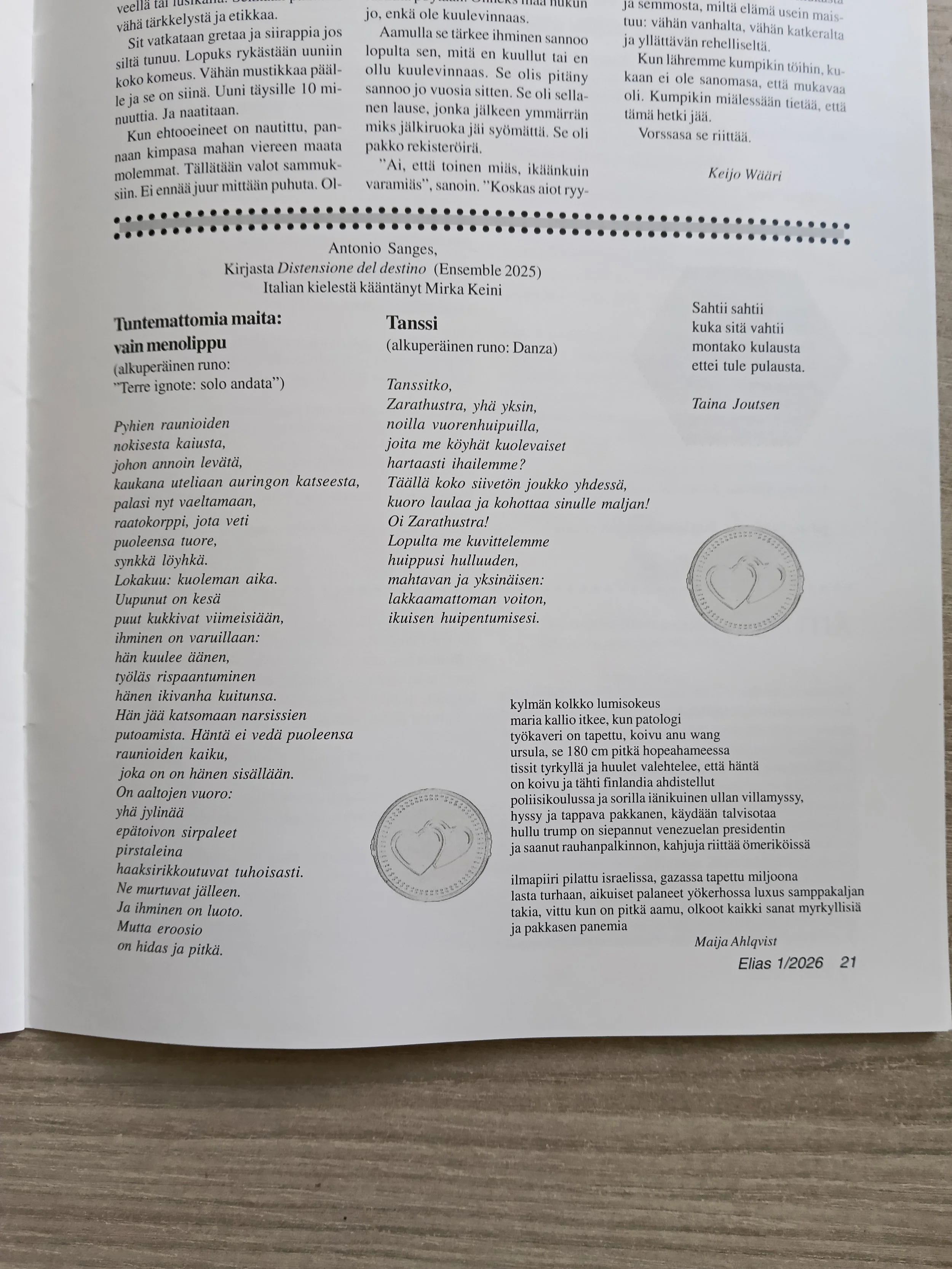
Danza and Terre ignote: solo andata translated into Finnish by Mirka Keini and published in Elias 1/2026.
INTERVIEWS
Interview with Fabio Sebastiani, per Transitiamumani
Interview by Giorgio Galli, Il Detonatore Magazine (pp. 88-102)
“IL MONDO CONTEMPORANEO? È UNA TRAGEDIA AL QUADRATO PERCHÉ LA VITA NON È MAI DAVVERO TRAGICA”: INTERVISTA AD ANTONIO SANGES (a cura di Giorgio Galli)